
The Quiet Architecture of Power
What happens in a room when “no” has nowhere to go
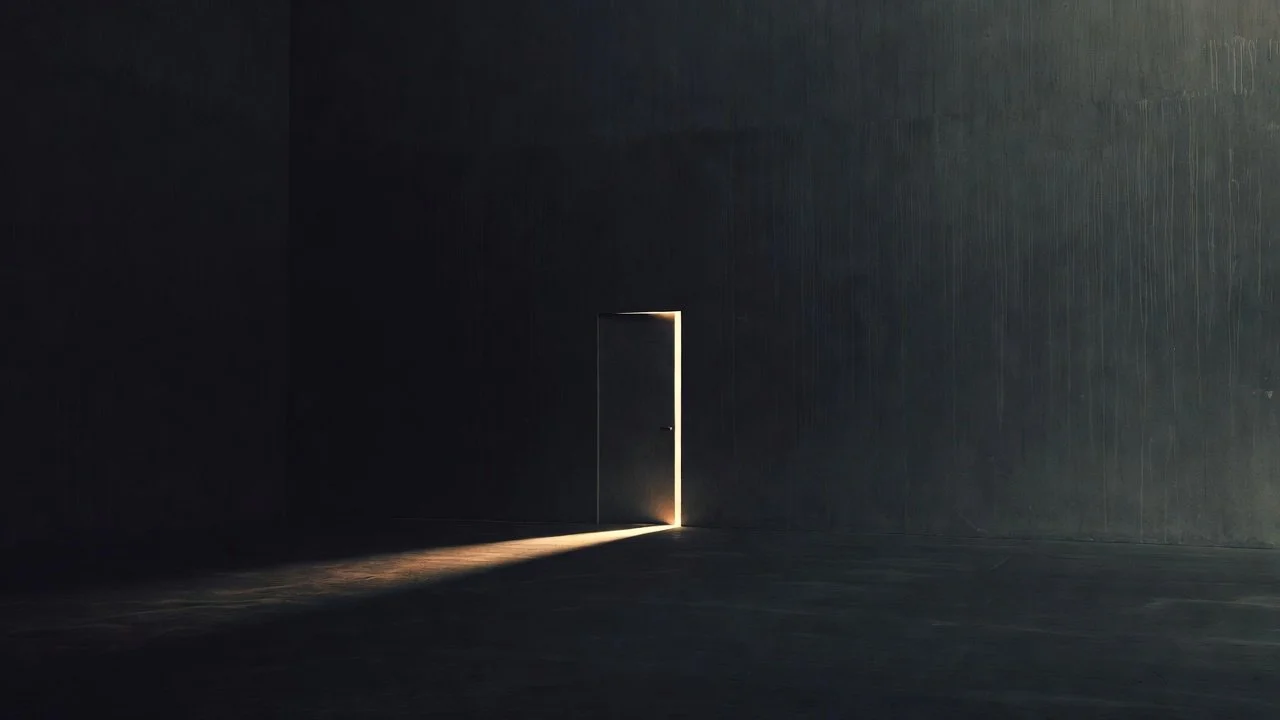
She is fourteen, or fifteen, or sixteen. It does not matter to the men who use numbers the way they use everything else, as a way to keep the world clean enough to touch. In her world, age matters because it decides what she is allowed to know, what she is allowed to say, what she is allowed to refuse. In their world, age is just a detail that must be managed.
She is told there is work.
Not work like her mother understands it, tired feet and receipts and a kitchen that never really rests. Work with softer edges. Work that comes wrapped in phrases like “easy,” “quick,” “he helps girls,” “it’s safe,” “you’re lucky.” Words that feel like a warm jacket until she realizes they are a blindfold.
The first time she walks toward the house, she is holding herself together in the way a child does when she is asked to act like an adult. She thinks about what she will buy. She thinks about being useful. She thinks about not being a burden. She is not thinking about danger. Nobody teaches you to recognize danger when it arrives wearing politeness.
Inside, everything is too quiet.
Quiet is supposed to mean peace, but here it means control. The air is conditioned into obedience. The floors shine like they were polished with silence. The doors are heavy. The rooms are large in the way that makes you feel smaller, as if the building is already telling you the truth, you do not belong here, you are not meant to stand upright in this place.
A woman, older, composed, speaks with a smile that does not reach the part of her face that would make it real. The girl’s name is said like a label, not like a person. Instructions arrive gently, almost kindly, like a hand guiding her shoulder into a position she did not choose.
She is brought into a room.
He is waiting.
He does not look like a monster. That is the trick that makes monsters effective. He looks like someone who has never had to explain himself. Someone who expects the world to be arranged around him the way furniture is arranged in his rooms.
He speaks in a calm voice. Calmness is power when you are the one who sets the rules. Calmness is what a predator uses when the prey is already trapped.
He offers something that pretends to be a choice.
And the girl, in that moment, learns a new physics of reality. She learns how the word “no” can evaporate in the mouth. She learns how a body can keep breathing while the mind tries to leave. She learns how shame can arrive instantly, not because she did anything wrong, but because the human nervous system will blame itself before it blames a world too big to fight.
She tries to become invisible.
That is what powerlessness is. It is not only fear. It is a shrinking. It is the body deciding that the safest shape is smaller.
There are no graphic details in this story because the details are not the point. The point is the mechanism. The point is that a child is in a closed room with an adult who has built a life around getting away with whatever he wants. The point is that the adult is not improvising. This is not an accident. This is a system that has been rehearsed.
Afterwards, she is handed money. Not as payment, but as a spell. A transaction is easier to deny than a violation. A transaction makes it easier for the powerful to sleep, because it lets them tell themselves a lie, that consent can be purchased the way fruit can be purchased.
She walks back out into the daylight and feels like she is wearing someone else’s skin. The sky is the same as it was before she went in, and that is the strangest part. The world does not react. The world does not pause. No alarm goes off. No adult rushes in. Nothing breaks to prove that something was broken.
She will try to speak later, maybe not immediately, maybe never, because speaking is dangerous in a world that rewards silence. Speaking is a risk when you have no network, no money, no lawyers, no reputation. Speaking is a risk when the other side has a name that opens doors and your own name barely opens your school locker.
She will discover, slowly, what it means to be trapped not only by a man, but by a culture of disbelief. People will ask why she went. People will ask why she returned, if she returned. People will ask why she did not scream, why she did not run, why she did not fight, as if the correct behavior would have magically rewritten the power imbalance.
It is always the powerless who are asked to behave perfectly.
Meanwhile, he continues.
He is not hiding in the way frightened people hide. He is hiding in the way kings hide, in plain sight, behind the curtain of status. His protection is not only wealth, it is his ability to make others feel that proximity to him is valuable.
He has learned the oldest lesson of finite play.
Create a closed arena. Control the entry. Control the rules. Control the story.
Make people compete for access, then you never have to force loyalty. They will volunteer it.
The men who come to him, the “customers,” are rarely described as men in the public imagination. They are described as “powerful people.” That adjective acts like anesthesia. It makes the reader numb. It makes the scene abstract. It makes the whole thing feel like a movie about elites rather than a sequence of rooms where a child’s life is bent into a shape it will never fully return from.
But in the room, there are only two truths.
A child.
And an adult who has decided she is not fully human.
If James Carse were standing behind the door, he would not need a scandal to recognize what is happening. He would see a finite game.
Finite players do not play to grow. They play to win. They require boundaries. They require roles. They require secrets. The finite player does not meet another person and ask, “Who are you becoming?” He asks, “What can you be used for?”
Epstein, in this reading, is not simply a criminal. He is the purest expression of the finite player’s hunger. He did not want a relationship with the world. He wanted ownership of a private world.
The closed room is the finite player’s cathedral.
The victims are not people in that cathedral. They are proof.
Proof that the rules are his.
Proof that he can do what others cannot.
Proof that he is above consequence.
And then the finite game does what finite games always do.
It ends.
Not because the finite player decides to stop. Finite players do not stop. They escalate. They add locks. They add intermediaries. They add layers of deniability. They perfect the mask. They grow bolder, because boldness is how the finite player proves to himself that he is still winning.
The game ends when the arena opens.
When law, public scrutiny, testimony, evidence, time, and sheer accumulation pry open the door.
When the closed room becomes part of the world again.
We often talk about the collapse as if it is a legal event, an arrest, a trial, a death in a cell. But the deeper collapse is metaphysical. A finite player builds his identity on control. Remove control and you remove the self he has built.
Now he is dead.
And we are left with a strange temptation.
The temptation is to imagine that because the player is gone, the game is over.
But Carse would warn us here. Finite players rarely die alone. Their games can be inherited. Their systems can be replicated. The architecture can remain even when the architect disappears. The doors can still be heavy. The silence can still be conditioned into the walls.
The question becomes, what kind of players will we be as a society in the aftermath?
A finite response is predictable.
It looks for trophies. It looks for lists. It looks for the single document that ends the story. It looks for the perfect villain so that we can go back to sleep believing the problem was one man, an exception, a monster.
The finite response turns justice into entertainment. It turns suffering into a storyline. It turns victims into footnotes and names into headlines.
It is another closed arena, just with different spectators.
An infinite response is harder.
It insists that the point is not only punishment, but prevention. Not only scandal, but structure. Not only outrage, but redesign.
An infinite response asks what must be opened so this game cannot be played again.
It asks why the powerless are left alone in rooms like that.
It asks why “access” is treated like virtue.
It asks why institutions move slowly until the powerful are embarrassed.
It asks why survivors must speak perfectly to be believed.
It asks why money can buy silence at all.
And then it does something unglamorous. It builds.
It strengthens exit routes. It funds support systems. It reduces the power of secrecy. It creates conditions where a fourteen-year-old can say “no” and be backed by something larger than her own trembling voice.
Because the most personal truth in this story is also the most universal.
In the room, she was alone.
That is what the finite player depends on, isolation. Isolation is the real locked door.
If I write this as a story, it is not to force the reader to imagine horror for the sake of sensation. It is to drag the moral center back to where it belongs, to the one-on-one scale where evil actually happens.
A child in a room.
An adult who has turned life into a closed game.
And a society that must decide whether it will keep producing closed rooms, or whether it will open the field so that life can continue as something other than a tournament.
Epstein’s finite game collapsed with him.
But the infinite game, the only one worth playing, starts when we refuse to let the next closed room be built quietly.
And we make sure that the next girl is not alone when she reaches for the word “no.”
